What Beverage Brand Owners Should Put in Their Co-Packer Tech Pack
A good beverage tech pack does more than tell a contract beverage co-packer what to make. It tells the plant how the product behaves.
That distinction matters when your formula includes tea solids, fruit bases, botanicals, plant proteins, fibers, sweetener systems, stabilizers, or functional ingredients that can change viscosity, haze, filtration load, tank turnover, and fill-line reliability.
For beverage brands, the tech pack is also where enzyme strategy belongs. Not as a vague processing note. As a controlled production input with a clear purpose, addition point, hold window, target outcome, and documentation path.
Switchyard Catalytics works as an enzyme supplier for beverage co-packers and brand teams that need predictable trials, clean changeovers, and fewer surprises between bench formula and commercial run.
The tech pack is a production control document, not just a recipe
Most tech packs include formula percentages, ingredient suppliers, packaging specs, and quality targets. Those are necessary, but not enough for a co-packer running multiple SKUs across shared tanks, filters, pasteurizers, and filling lines.
Your tech pack should help answer plant-floor questions before the first batch is scheduled:
- Will this product build viscosity in the tank?
- Will solids settle, swell, or shear differently during agitation?
- Will it blind filters or slow clarification?
- Is haze expected, controlled, or a defect?
- Does the process need an enzyme step to improve throughput, texture, extractability, or visual stability?
- What must be recorded in the batch sheet?
- What are the stop/go checks during the trial?
The better your tech pack answers those questions, the easier it is for the co-packer to quote accurately, assign equipment, plan changeovers, and scale the first run without excessive rework.
Include the product behavior profile
Start with a practical description of how the beverage should behave in production. This is not marketing language. It is operating language.
Include:
- Expected viscosity range or flow behavior by process stage
- Whether particulates, pulp, fibers, or suspended solids are intentional
- Expected clarity, turbidity, or haze appearance at release
- Whether haze is acceptable, conditional, or a failure
- Sensitivity to heat, pH shift, shear, oxygen, or long tank holds
- Foam tendency during batching, transfer, or filling
- Any known sedimentation, ring formation, cloud loss, or gel formation risk
If you are developing juice blends, functional waters, brewed tea, coffee beverages, plant-forward drinks, or botanical extracts, this section can prevent a costly misunderstanding. A beverage that looks acceptable in a lab bottle may behave very differently through a production pump, plate heat exchanger, cartridge filter, or multi-hour hold.
Define why an enzyme is being used
Do not list an enzyme as a generic aid. State the operational reason.
Common production objectives include:
- Reducing mash or fruit-base viscosity before transfer
- Improving press yield or extraction consistency
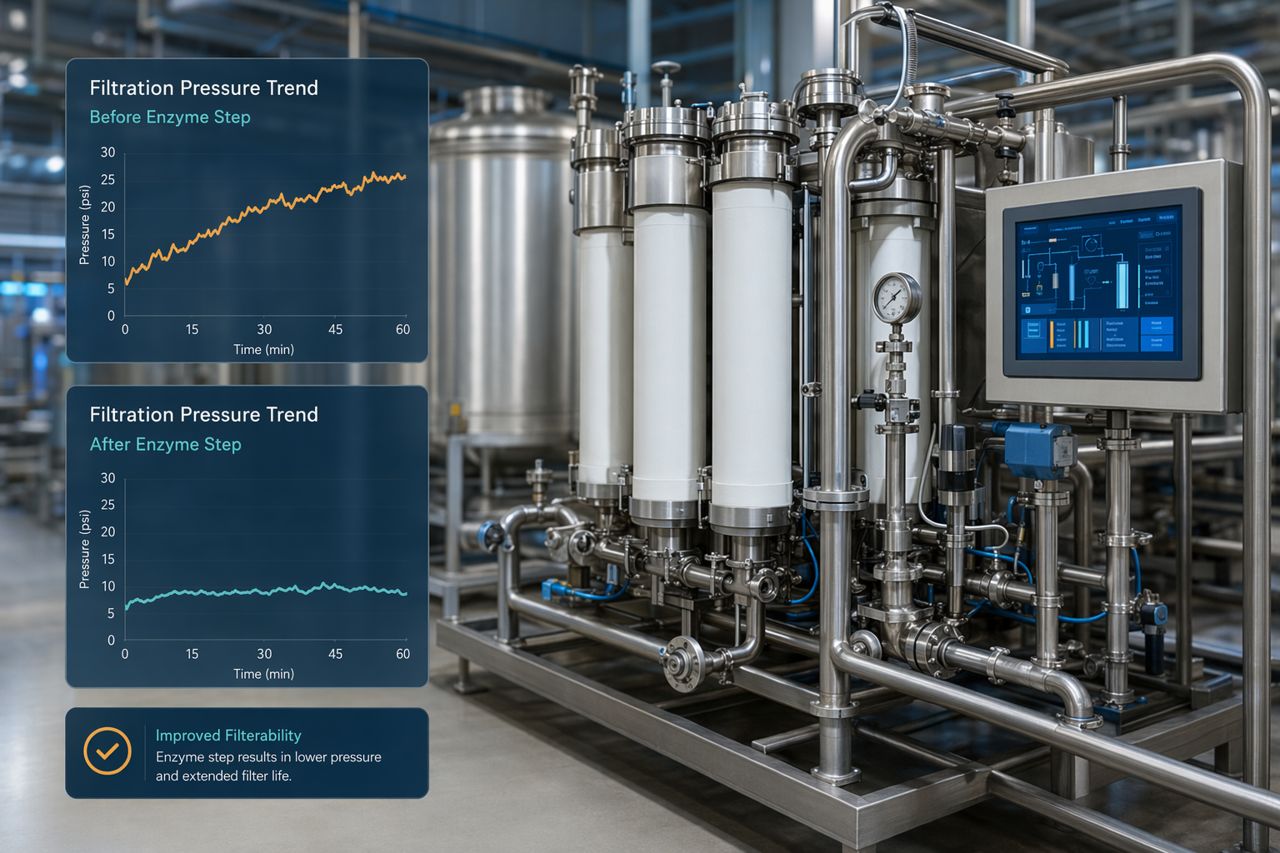
- Relieving filtration load
- Reducing haze-forming components
- Supporting more consistent clarification
- Improving tank drain-down and turnover
- Helping stabilize appearance across shelf-life targets
- Managing difficult botanical or plant-based solids
This gives the co-packer a reason to protect the enzyme step instead of treating it as a flexible note that can be moved, shortened, overheated, or skipped under schedule pressure.
Specify the enzyme process window in plant terms
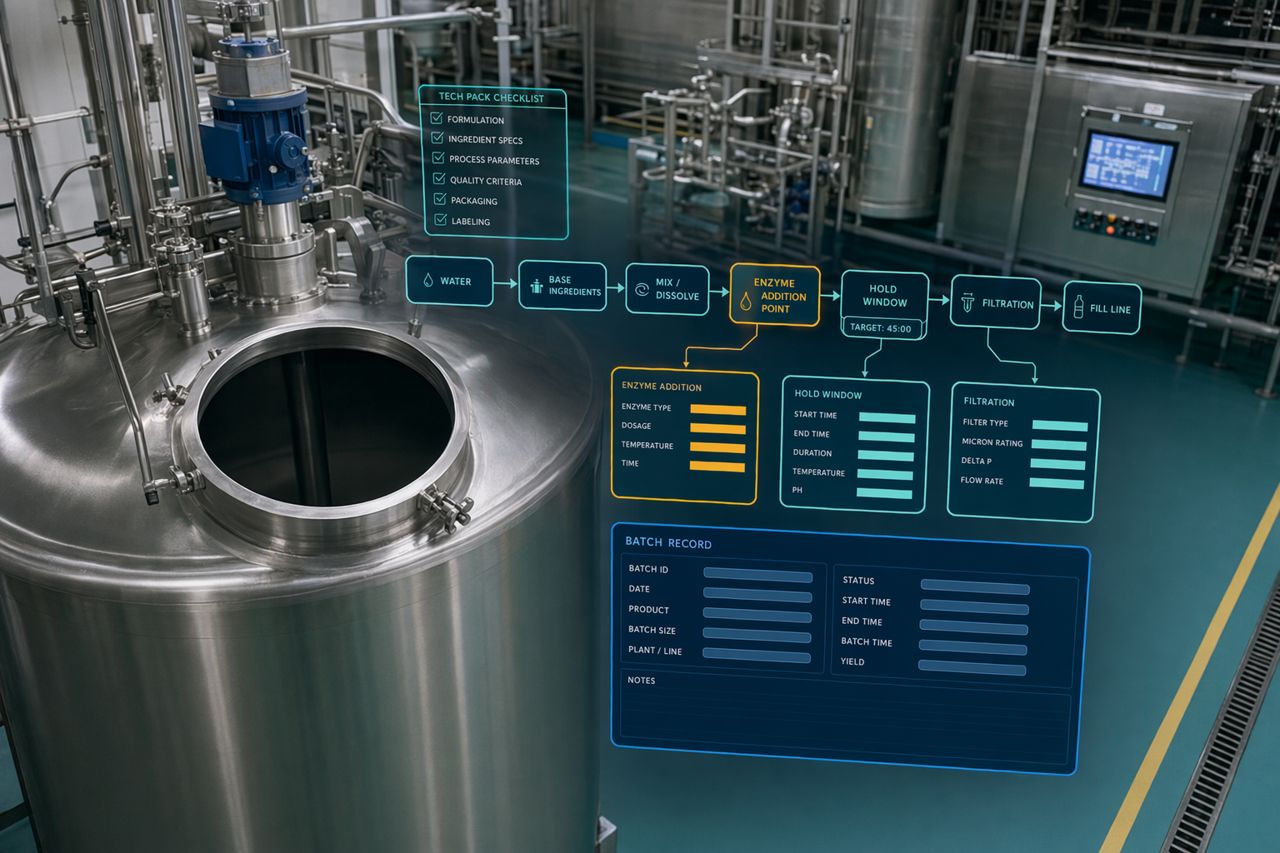
Your tech pack should describe the enzyme step in a way the production team can execute and document.
Include:
- Product stream or batch stage where the enzyme is added
- Target tank, kettle, blend vessel, or inline addition point
- Mixing expectation after addition
- Hold time range
- Temperature range
- pH range
- Whether the step occurs before or after heat treatment
- Whether the enzyme is expected to be deactivated, removed, or carried through
- Any filtration, centrifuge, settling, or clarification step that follows
Avoid burying this information in R&D notes. Put it into the process flow and the batch record expectations.
Connect enzyme use to co-packer constraints
Co-packers care about line time, tank time, labor, cleaning, wastewater load, filter life, and schedule risk. Your tech pack should show that the enzyme step has been designed around those constraints.
Address:
- Added hold time versus saved filtration time
- Whether the step can fit inside existing batch staging
- Whether the enzyme addition changes CIP requirements
- Compatibility with current tanks, mixers, pumps, and filter trains
- Whether the process protects line speed on the filler
- Whether the step creates any special allergen, labeling, or documentation review need
A well-designed enzyme step should not feel like a science project dropped into a production schedule. It should feel like a controlled way to make the beverage run better.
Add a trial plan the plant can actually run
A commercial trial should have a clear purpose and a tight decision structure. Do not ask a co-packer to “see how it goes.”
Include a trial page with:
1. Trial objective
Examples:
- Reduce filtration pressure rise during clarification
- Improve tank emptying and reduce heel loss
- Reduce visible haze drift after hot fill or tunnel pasteurization
- Improve transfer behavior of a fruit or botanical base
- Confirm the enzyme step fits inside the existing batch cycle
2. Trial batch size and equipment
Name the intended tank, mixer, pump path, heating or cooling system, filter type, and filling line if known.
3. Control and test comparison
If possible, define a control process and the enzyme-supported process. The comparison does not need to be complicated, but it must be fair enough to support a go/no-go decision.
4. Observations to record
Ask the plant to capture operational observations, not just finished product results:
- Mixing behavior
- Foam behavior
- Transfer time
- Filter loading pattern
- Pressure trend across filtration
- Tank drain-down behavior
- Sediment or haze observations
- Any deviation from the planned hold window
- Operator comments from batching and filtration
5. Decision criteria
Define what success looks like before the trial starts. For example:
- Filtration completes without unplanned filter change
- Product meets clarity or haze target after processing
- Viscosity remains compatible with existing pumps and filler
- No changeover or CIP penalty is introduced
- The process fits inside the co-packer’s batch schedule
Include documentation the co-packer will request
Brand owners can speed up onboarding by organizing the technical file before the plant asks for it.
Your enzyme-related documentation packet may include:
- Product name and intended use statement
- Ingredient declaration support
- Regulatory and food-contact suitability documentation where applicable
- Allergen and dietary suitability statements where applicable
- Storage and handling requirements
- Shelf-life and lot coding information
- Safety data sheet
- Batch record language for enzyme addition
- Deviation guidance if the process window is missed
- Contact path for technical support during first production
The goal is not paperwork for its own sake. The goal is to remove uncertainty from scheduling, QA review, purchasing, and the first production run.
Do not leave the co-packer guessing on haze
Haze is one of the most common sources of disagreement between brand, R&D, QA, and production.
Some beverages are supposed to be brilliant and clear. Some are intentionally cloudy. Some can tolerate natural variation. Some cannot. Your tech pack needs to say which one you are making.
For haze-sensitive beverages, include:
- Target appearance at release
- Expected appearance after heat treatment
- Acceptable variation by flavor or ingredient lot
- Whether chill haze is a concern
- Whether botanical, tea, fruit, or protein interactions are expected
- Whether enzyme processing is intended to reduce haze precursors
- Visual standard photos under consistent lighting
This protects the co-packer from making production decisions based on subjective appearance alone.
Treat viscosity as a scheduling issue
Viscosity is not only a mouthfeel attribute. In a co-packing plant, it affects batching time, pump load, heating, cooling, filtration, filler performance, tank turnover, and cleanup.
If your formula includes fruit puree, soluble fiber, oats, gums, plant proteins, syrups, or botanical extracts, include viscosity notes by stage:
- After initial hydration or blending
- After enzyme hold, if used
- After heat treatment
- Before filtration
- At filler feed
- After overnight or extended hold, if allowed
If enzyme processing is intended to reduce viscosity or prevent process thickening, state that clearly and tie it to the process step.
Build the enzyme step into the quote request
If the enzyme process affects tank occupancy, filtration time, labor, or testing, it should be visible in the quote request. Hiding it until trial day usually creates friction.
Your RFQ package should include:
- Formula and process flow
- Enzyme addition point and hold window
- Expected annual and per-run volume
- Packaging format and line requirements
- Filtration or clarification expectations
- Heat treatment requirements
- Finished product quality targets
- Trial plan and decision criteria
- Documentation packet status
This helps the co-packer price the work accurately and helps the brand avoid late-stage change fees or failed production assumptions.
A simple co-packer tech pack checklist
Use this as a working structure:
- Product overview and intended finished appearance
- Formula with supplier and ingredient function notes
- Process flow with equipment assumptions
- Critical process parameters
- Enzyme purpose, addition point, and process window
- Mixing, holding, heating, cooling, and filtration expectations
- Quality targets for pH, Brix, color, haze, flavor, and fill specs
- Viscosity and flow behavior notes
- Packaging and coding requirements
- Allergen, regulatory, and certification documentation
- Batch record language
- Trial plan with operational observations
- Go/no-go criteria
- Deviation guidance
- Technical and commercial contact list
Where Switchyard Catalytics fits
Switchyard Catalytics supports beverage brands and co-packers when enzyme selection needs to translate into production behavior. We help align the enzyme step with real plant constraints: tank time, filtration relief, haze control, viscosity management, changeover discipline, and documentation readiness.
If you are preparing a beverage tech pack for a co-packer, bring us in before the first trial. The earlier the process window is defined, the easier it is to run a clean trial and build a quote the plant can stand behind.
Request a quote
Planning a co-packed beverage run with an enzyme-supported process step? Use the on-site request a quote form to share your product type, process goals, expected run size, and co-packer constraints. We will help map the enzyme requirement into a practical production plan.